
LLM SEO Fundamentals
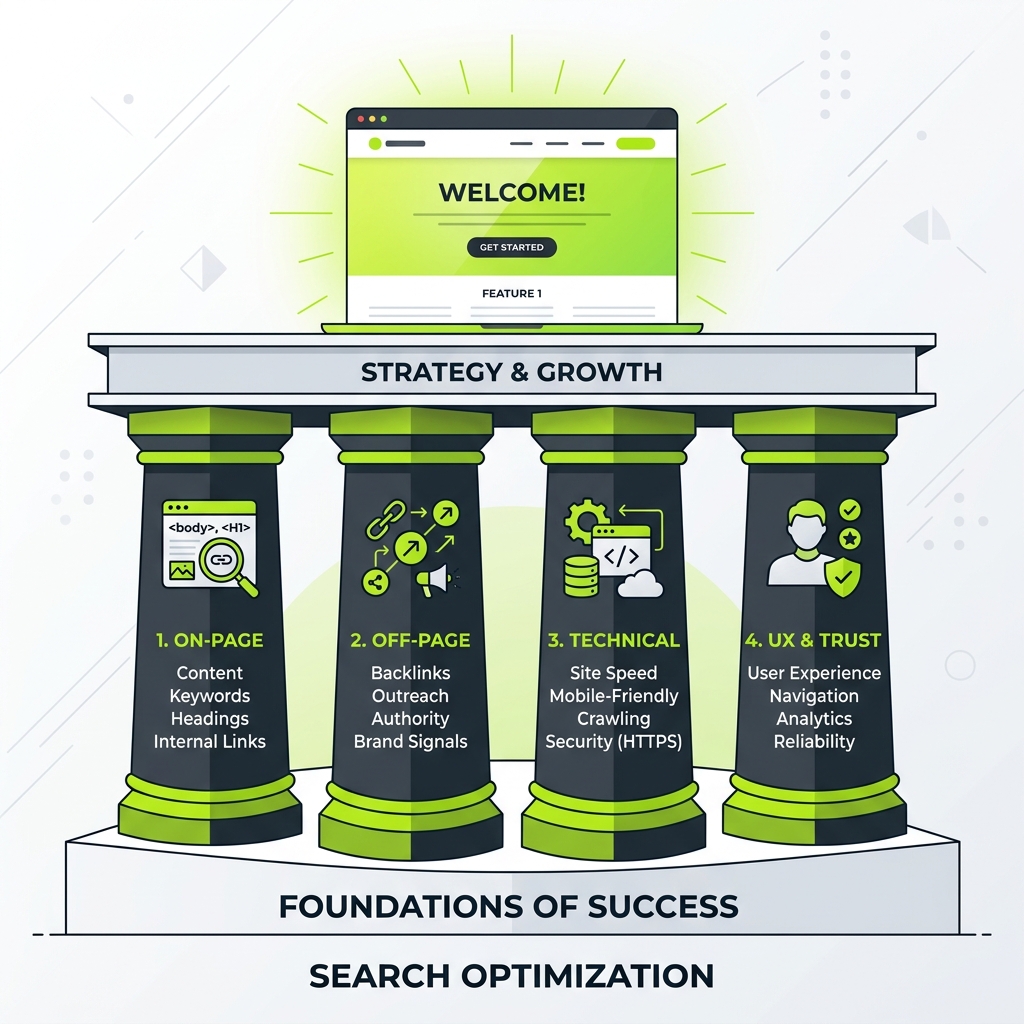
To optimize for a Large Language Model (LLM) and secure citations in Answer Engines, you must fundamentally change how you write and format your content. You must understand how an LLM "reads."
LLMs do not care about your website's beautiful design, CSS animations, or clever branding copy. They ingest the raw text and HTML structure of your page. They use complex vector mathematics to look for clear semantic relationships, undeniable facts, and trusted authority signals.
Here are the foundational pillars of LLM Optimization in 2026.
1. High Information Density (The "Cut the Fluff" Rule)
LLMs are fundamentally trained to summarize. In a Retrieval-Augmented Generation (RAG) system, the AI grabs a small "chunk" of your text to answer a user's prompt.
If your article takes 500 words of rambling introductory prose to explain a concept that could be stated in 50 words, the LLM will struggle to extract the core facts. It will likely bypass your content for a competitor who gets straight to the point.
Actionable Steps:
- BLUF (Bottom Line Up Front): Answer the core question of your article in the very first paragraph.
- Eradicate "Recipe Blog Syndrome": Do not write long personal stories before getting to the data.
- Maximize Formatting: Use bullet points, bold text for key metrics, and short, punchy paragraphs. Make every sentence earn its place.
2. Semantic HTML Structure
When an LLM parses a web page, it relies heavily on standard HTML tags to understand the hierarchy and relationship of your content. A visually large font means nothing to an AI; an <h2> tag means everything.
Actionable Steps:
- Strict Heading Hierarchy: Your
<h1>is the main topic. Your<h2>tags are major subtopics. Your<h3>tags support the<h2>s. Never skip heading levels (e.g., jumping from<h1>to<h3>) just for visual styling. - Use Native List Tags: If you have a list of items, use actual
<ul>(unordered) or<ol>(ordered) tags. Do not use dashes or asterisks inside a standard<p>tag. - Tabular Data Needs Tables: If you are comparing pricing, features, or specifications, use a proper HTML
<table>. LLMs are highly trained to parse and extract facts from clean HTML tables.
3. Entity Optimization & Vector Search
An "Entity" is a distinct, well-defined concept, person, organization, or thing. Traditional search looked for keywords; modern Answer Engines map relationships between entities using Knowledge Graphs and Vector Embeddings.
For example, if you write about "Apple," the LLM looks at the surrounding text (the semantic vector space) to understand if you mean the fruit, the tech giant, or a record label.
Actionable Steps:
- Unambiguous Language: Use precise terminology. Instead of saying "the company announced a new phone," say "Apple Inc. announced the iPhone 16 Pro."
- External Entity Linking: Link out to authoritative entity hubs. If you mention a complex concept, link to its Wikipedia page or official documentation. This helps the AI anchor your text to established entities.
- Become an Entity: Build a comprehensive "About Us" page that clearly states who you are, what you do, who your founders are, and where you are located. Use Schema markup to explicitly define this.
4. The Power of Co-Citation
LLMs decide what is "true" based on consensus across their training data and RAG retrieval sources. If five highly authoritative websites all state that "Next.js is the most robust React framework," the LLM treats that as a concrete fact.
If you want an Answer Engine to recommend your software tool, product, or service, you need other authoritative websites in your niche to mention your brand in the same context as your competitors. This is called Co-Citation.
How to Build Co-Citation:
- Digital PR: Focus on getting mentioned in industry roundups, "Best Tools of 2026" lists, and podcast transcripts.
- Guest Authoring: Write expert articles on high-authority domains in your niche. Ensure your author bio clearly links your name (Entity A) to your company (Entity B).
- The Proximity Effect: The closer your brand name appears to a target concept (e.g., "CRM software") across the web, the more likely the LLM is to associate the two.
By mastering these fundamentals, you transform your website from a collection of web pages into a structured database of facts that Answer Engines love to cite.