
A/B Testing & Experiments
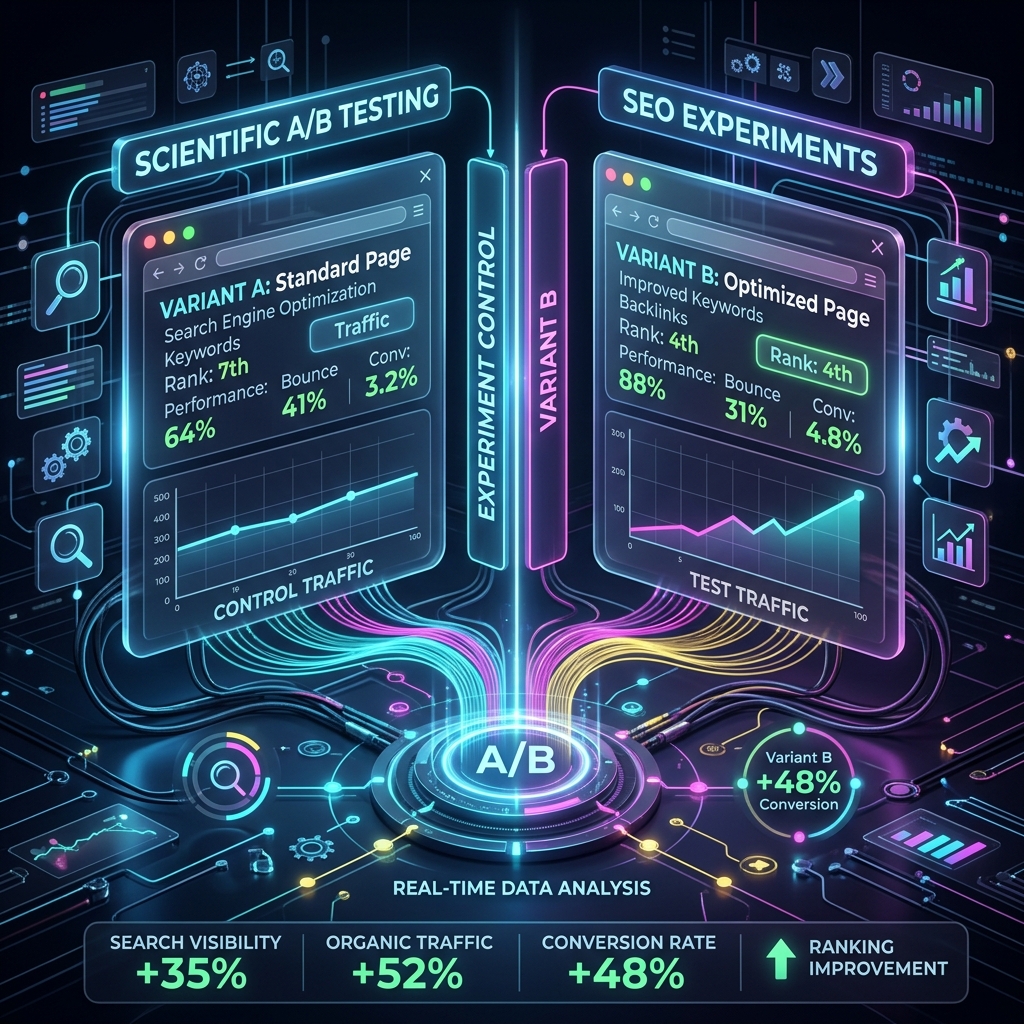
SEO is not guessing; it is applied data science. Once a page successfully ranks on Page 1 of Google, the most cost-effective and fastest way to increase your traffic is through rigorous A/B testing of your metadata.
If you rank #3 for a keyword, you might be capturing 10% of the total clicks. If you rewrite your Title Tag to be drastically more compelling, you might jump to a 15% Click-Through Rate (CTR). That is a 50% increase in traffic without building a single backlink or writing a single new paragraph of content.
1. The Mechanics of an SEO Split Test
Unlike traditional CRO (Conversion Rate Optimization)—where tools like Optimizely or VWO show Version A to half your users and Version B to the other half simultaneously—SEO testing is primarily sequential (time-based).
Because Googlebot only crawls one version of the page at a time, you must test chronologically.
The 5-Step Scientific Testing Protocol
- Record the Baseline: Note the exact CTR, Impressions, and Average Position in Google Search Console over a strict 14-day or 28-day period. Ensure there are no major holidays or seasonal spikes during this window.
- Formulate a Hypothesis & Make the Change: Document why you are making the change. For example: "Adding the current year
[2026]will signal freshness and increase CTR." Update the Title Tag or Meta Description in your CMS. - Force Re-indexing (Crucial): Go immediately to Google Search Console, paste the exact URL into the top search bar, and click "Request Indexing." This forces Google to crawl the new Title Tag so the test begins immediately, rather than waiting days for an organic crawl.
- Wait the Exact Same Duration: Let the new title sit in the search results for exactly the same amount of time as your baseline (e.g., 14 days).
- Analyze the Data: Did the CTR go up or down? Did the Average Position change? If CTR went up with statistical significance, keep the new version. If it dropped, revert immediately.
2. High-Impact Testing Frameworks for 2026
What should you actually be testing? Here are the highest-ROI experiments:
- Freshness Signals: Appending the current month or year (e.g.,
Best CRM Software (Updated Jan 2026)). - Brackets and Parentheses: Visual breaks stand out in a wall of text. (e.g.,
How to Fix a Leaky Faucet [Step-by-Step]). - Exact Numbers & Data: Using specific numbers rather than vague claims. (e.g.,
Save $400 on Car Insuranceinstead ofSave Money on Car Insurance). - Emotional Triggers / Power Words: Using words that evoke curiosity or urgency (e.g.,
Proven,Mistakes,Secret,Fast). - Removing the Brand Name: If your brand isn't famous, test removing
| Company Namefrom the end of the title tag to free up characters for more compelling copy.
3. Advanced Edge Testing (Enterprise SEO)
If you manage a massive website with millions of programmatic pages (like an e-commerce store with 50,000 product pages), you can run simultaneous split tests.
This requires splitting your templates. You apply Title Format A to 25,000 product pages, and Title Format B to the other 25,000. You then monitor the aggregate organic traffic lift across the two cohorts using tools like SearchPilot or SplitSignal. This is highly advanced but is standard practice at enterprise companies like Zillow, Pinterest, or Amazon.
Severe Warning: Cloaking
Never use JavaScript to show one version of a page's content to Googlebot and a completely different version to human users in an attempt to A/B test organic content. This is considered "Cloaking," a severe violation of Google's Webmaster Guidelines. If caught, your site will be hit with a manual penalty and de-indexed from Google entirely.