
Optimizing for AI & Voice: Answer Engine Optimization (AEO)
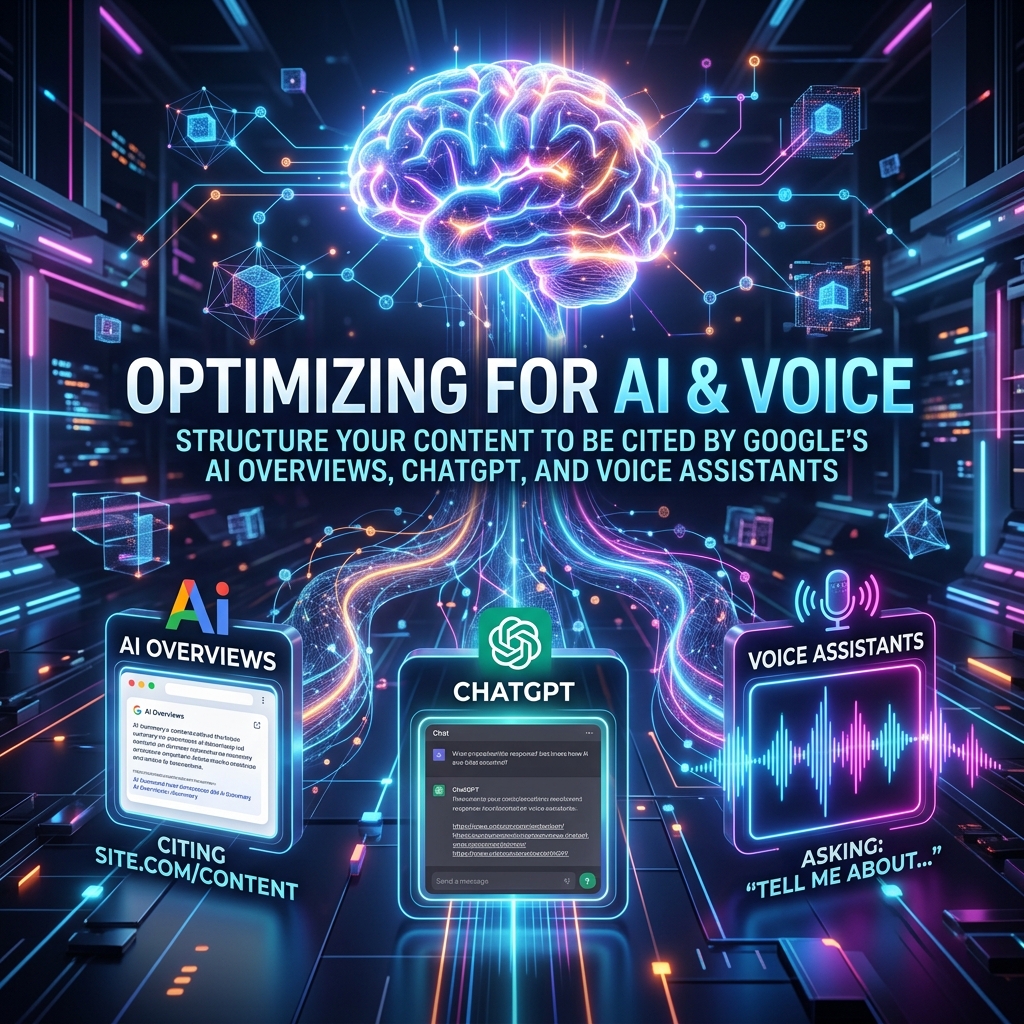
The search landscape has fundamentally shifted. Users are increasingly bypassing traditional "10 blue links" and turning directly to generative AI (Google's AI Overviews, ChatGPT, Perplexity, Claude) and Voice Assistants (Siri, Alexa) to get immediate answers.
Your new SEO goal isn't just to rank on a webpage—it is to be the foundational source data that the LLM (Large Language Model) cites. This is the discipline of Answer Engine Optimization (AEO).
How AI Models Choose What to Cite
LLMs process information differently than traditional search crawlers. They look for high semantic density, undeniable entity authority, and strictly structured facts.
1. The Q&A Format (The "Target Paragraph")
AI overviews love extracting concise, factual snippets. The easiest way to get cited is to explicitly ask the user's question in an H2 or H3 tag, and then immediately answer it in a single, highly structured paragraph underneath.
- H3 (The Query): How often should you change your car's oil?
- Paragraph (The Target): Most modern cars require an oil change every 5,000 to 7,500 miles. However, if your car uses synthetic oil, you may be able to wait up to 10,000 miles. Always check your specific vehicle's owner's manual for exact intervals.
2. Entity Optimization
Generative AI relies on the Knowledge Graph—a vast database of how "Entities" (people, places, concepts, brands) relate to each other.
- To be cited, your brand must become a recognized entity.
- Ensure you have a robust "About Us" page.
- Link out to highly authoritative external entities (e.g., academic papers, government sites).
- Consistently use the exact same terminology when discussing your core subject matter so the AI learns your definitions.
3. Structured Data (Schema Markup)
You must spoon-feed the AI models what your content is about using JSON-LD Schema markup. If you are writing a recipe, use Recipe schema. If you are answering questions, use FAQPage schema. If you are listing a product, use Product schema with precise price and availability attributes.
Mastering Voice Search
Voice search queries are fundamentally different from text queries.
- Text Query (Shorthand): "oil change intervals synthetic"
- Voice Query (Conversational): "Hey Siri, how often do I really need to change the synthetic oil in my car?"
Tactics for Voice Optimization
- Target Question Keywords: Voice searches overwhelmingly start with Who, What, Where, When, Why, or How. Use tools like AnswerThePublic to find these.
- Local Intent: Mobile voice searches often have extreme local intent ("near me"). Ensure your Google Business Profile is flawless.
- Readability Level: Voice assistants read answers out loud. If your sentences are 40 words long and full of academic jargon, the assistant will stumble. Keep reading levels at an 8th-grade standard. Use short, punchy sentences.
The Threat of "Zero-Click" Searches
A zero-click search occurs when the AI perfectly answers the user's question on the results page, so they never click to your website.
How to survive: Move away from simple, easily-scrapable facts (e.g., "What is the capital of France?"). Pivot your content to deep analysis, contrarian opinions, and first-hand experience. An AI can tell a user how to change a tire, but it cannot tell them which tire performed best during a muddy 500-mile road trip.
Action Plan for AEO
- Audit your top pages: Do they have a clear "BLUF" (Bottom Line Up Front) summary at the very top?
- Implement FAQ Schema: Find the 3 most common questions related to your top article, add them to the bottom of the post, and wrap them in FAQPage schema.
- Write Conversationally: Read your content out loud. Does it sound like a human talking to a friend, or a robot reciting a textbook? Adjust accordingly.