
What is Conversion Rate Optimization (CRO)?
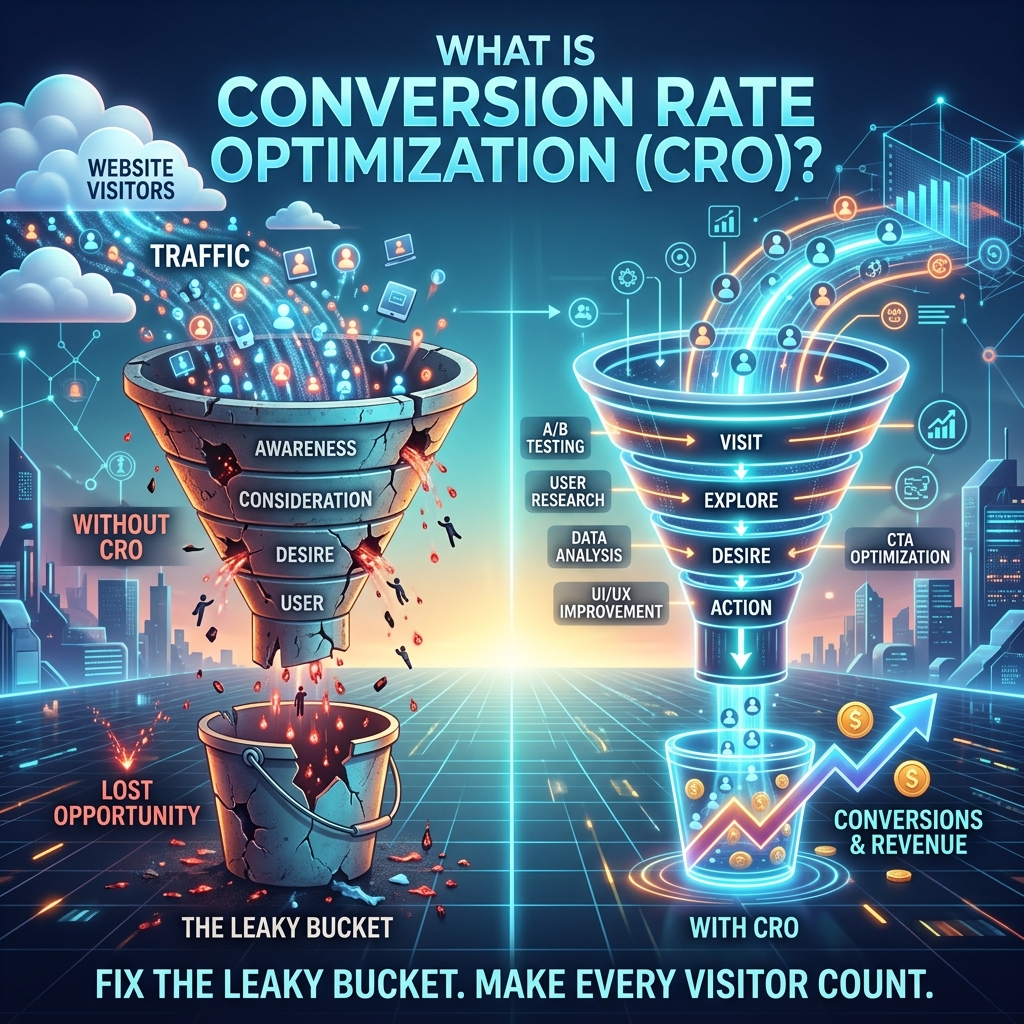
If SEO is the art of getting people to your website, Conversion Rate Optimization (CRO) is the art of getting them to actually do something meaningful once they arrive.
In the highly competitive landscape of 2026, you can rank #1 for every keyword in your industry, but if your website is confusing, untrustworthy, slow, or broken, that hard-earned traffic will generate exactly zero dollars.
The Math of CRO: Why It Outperforms Raw Traffic
Imagine you run an e-commerce store selling $100 specialized running shoes. Currently, you get 10,000 visitors a month, and your Conversion Rate is 1%.
- 10,000 visitors x 1% = 100 sales.
- 100 sales x $100 = $10,000 in Revenue.
You want to double your revenue to $20,000. You have two options:
- The SEO Route: Spend six months writing content, acquiring backlinks, and optimizing technicals to double your traffic to 20,000 visitors. This is expensive and slow.
- The CRO Route: Change the color of your checkout button, rewrite your product descriptions, and streamline the checkout flow to increase your Conversion Rate from 1% to 2%.
- 10,000 visitors x 2% = 200 sales.
- 200 sales x $100 = $20,000 in Revenue.
CRO is often significantly faster and cheaper than SEO. The most profitable companies in the world do both simultaneously: using SEO to fill the funnel and CRO to widen the bottom.
The "Leaky Bucket" Metaphor
Think of your website as a bucket, and your SEO traffic as water pouring into it.
If your website has a terrible mobile experience, confusing navigation, slow LCP (Largest Contentful Paint), and no clear pricing, your bucket is full of holes. The water just leaks out.
Before you spend thousands of dollars trying to pour more water (traffic) into the bucket, you must plug the holes (CRO).
What Constitutes a "Conversion" in 2026?
A conversion is any specific, measurable action you want a user to take. It changes based on your business model:
- E-commerce: Completing a purchase, adding an item to a wishlist.
- B2B SaaS: Signing up for a free trial, booking a demo, downloading a whitepaper.
- Local Service: Calling a phone number, submitting a quote form, getting directions via Google Maps.
- Media Publisher: Subscribing to a paid newsletter, clicking an affiliate link, watching a sponsored video.
Micro vs. Macro Conversions
- Macro Conversions: The primary goal (e.g., buying a product).
- Micro Conversions: Smaller steps that lead to the primary goal (e.g., adding to cart, watching an explainer video, signing up for the newsletter). Optimizing micro-conversions often leads to massive macro-conversion gains.
Actionable Next Steps
- Define Your Conversions: Clearly outline your 1 macro conversion and 3 micro conversions.
- Audit Your Bucket: Walk through your website on a mobile device and identify the biggest "hole" (e.g., a broken button, slow page load, confusing copy).
- Setup Tracking: Ensure Google Analytics 4 (GA4) or your analytics tool of choice is correctly tracking these conversion events.