
User Intent and Funnels
The biggest mistake in CRO is asking for marriage on the first date. If a user Googles "What is a CRM?", they are looking for information. If your page immediately pops up a full-screen form demanding their phone number, company size, and budget for a sales demo, they will leave immediately.
In 2026, search algorithms and users demand relevance. You must align your page design and your Call to Action (CTA) precisely with the user's Search Intent.
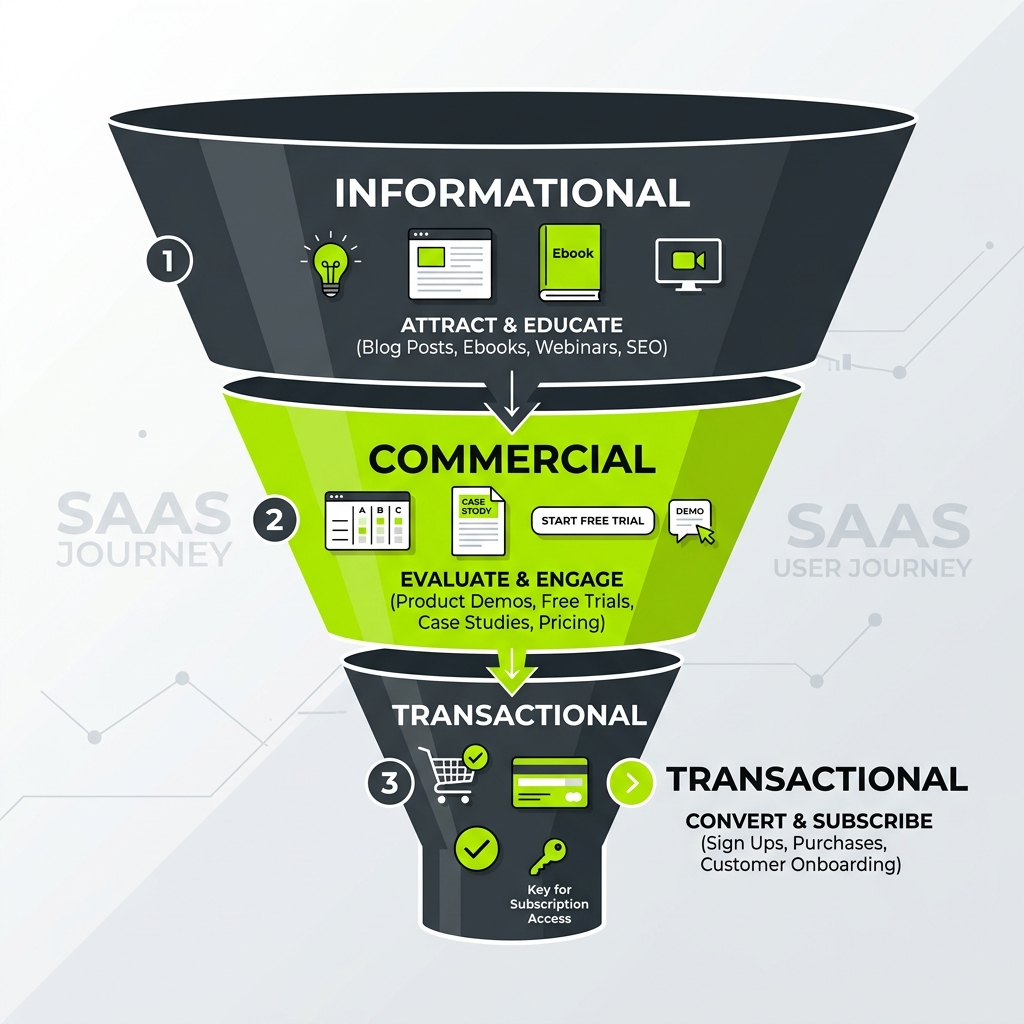
The Modern Marketing Funnel
The marketing funnel describes the psychological stages a user goes through before making a purchase. Your CRO strategy must adapt to each stage.
1. Top of Funnel (ToFu) - Awareness
- The Intent: The user is experiencing a problem and wants information. They are not ready to buy; they might not even know your product category exists.
- Example Keyword: "How to organize sales leads."
- The CRO Goal: Do not ask for a sale. Ask for permission to continue the conversation. Offer a free downloadable template, a comprehensive cheat sheet, or a newsletter subscription. The goal is lead capture (email address) so you can nurture them later.
2. Middle of Funnel (MoFu) - Consideration
- The Intent: The user knows the solution to their problem, and they are actively evaluating different vendors.
- Example Keyword: "Salesforce vs. Hubspot CRM."
- The CRO Goal: Build trust and logically prove superiority. Use comparison tables, video case studies, and feature breakdowns. The CTA should be a low-friction offer like "Watch a 5-Minute Demo Video," "Start a Free 14-Day Trial," or "Calculate Your ROI."
3. Bottom of Funnel (BoFu) - Decision
- The Intent: The user has their credit card in hand. They are ready to buy right now.
- Example Keyword: "Hubspot CRM pricing" or "Buy Hubspot CRM."
- The CRO Goal: Remove absolutely every point of friction. The page should have zero distractions. The CTA should be highly aggressive and crystal clear: "Buy Now," "Talk to Sales Immediately," or "Get a Custom Quote."
Mapping Keywords to Page Architecture
When designing a landing page, you must look at the primary keyword the page is optimized for in SEO, and structure the page's content ratio accordingly.
- Informational Pages (ToFu): If you rank for a ToFu informational keyword, your page should be 90% educational text and 10% soft CTAs (like an inline lead magnet or a sticky sidebar newsletter signup).
- Transactional Pages (BoFu): If you rank for a BoFu transactional keyword, your page should be 10% text and 90% conversion elements (pricing tables, trust badges, massive action buttons, and customer testimonials).
The "Micro-Yes" Sequence
Instead of asking for a massive commitment right away, build a funnel of "Micro-Yes" moments.
- Yes, I will click this search result.
- Yes, I will read this headline.
- Yes, I will scroll down.
- Yes, I will give you my email for this template.
- Yes, I will open your nurturing email.
- Yes, I will buy your product.
CRO is about optimizing every single transition between these "Yes" moments.
Actionable Next Steps
- Audit Intent Mismatch: Look at your top 5 highest-traffic blog posts. Are you asking for a hard sale (BoFu) on an informational (ToFu) article? If so, change the CTA to a lead magnet.
- Create a Comparison Page: If you don't have one, create a "You vs. Competitor" page to capture MoFu consideration traffic.
- Review Analytics Drop-offs: Use GA4 to see exactly which stage of your funnel has the highest drop-off rate, and focus your CRO efforts entirely on that specific bottleneck.