
Introduction to Search Rank Factors
Short Summary
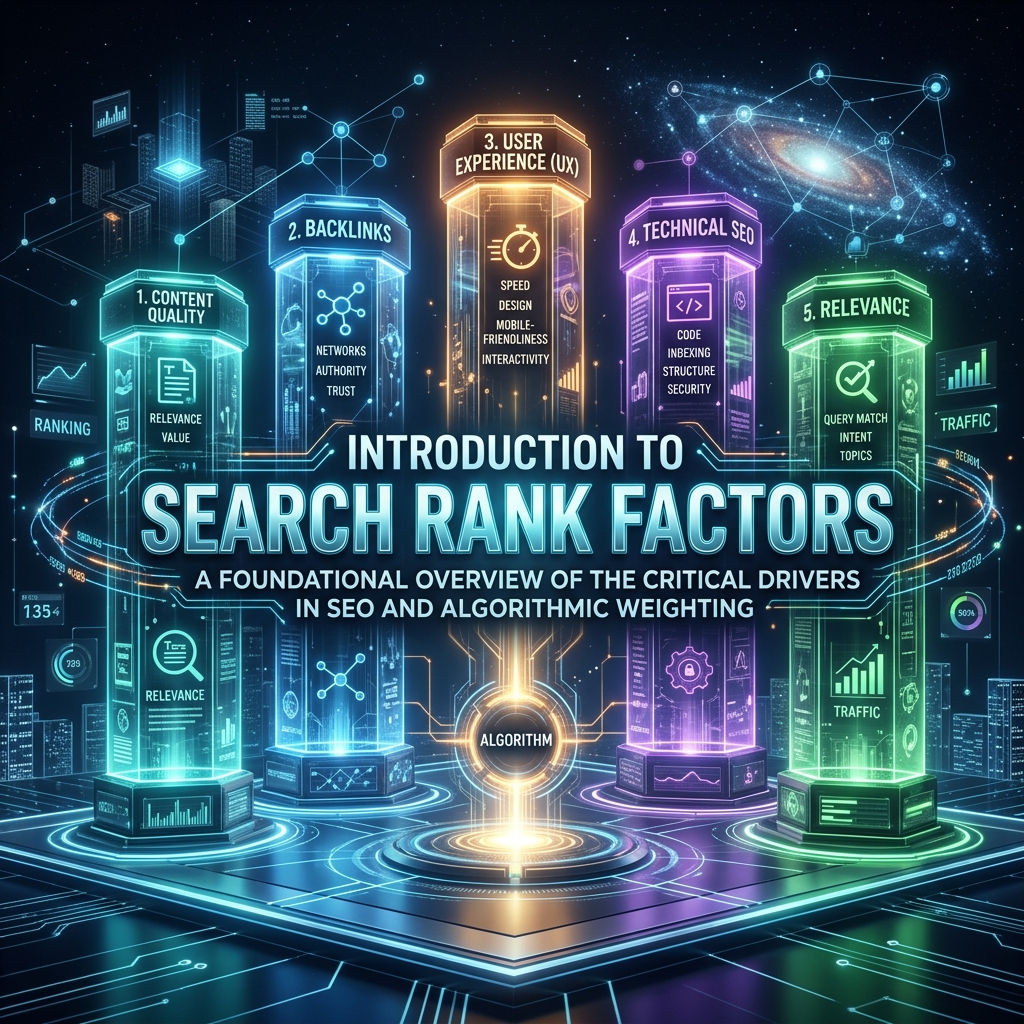
Google evaluates hundreds of dynamic ranking signals to determine who claims the coveted #1 spot in the SERPs. In this lesson, we demystify the algorithm by categorizing these complex signals into four highly actionable pillars: On-Page (Topical Relevance), Off-Page (Entity Authority), Technical Health (Crawlability/Speed), and UX/E-E-A-T (Trust). Understanding this matrix allows you to ruthlessly prioritize your agency's efforts for maximum ROI.
Explain Like I'm 10
Imagine you are hiring a general contractor to build your dream house. You want someone who strictly follows your blueprint (Relevance), comes highly recommended by every neighbor you trust (Authority), has the absolute best tools and an organized team (Technical), and looks incredibly professional and trustworthy when you meet them (UX/E-E-A-T).
Google wants exactly the same assurances before it recommends a website to millions of searchers.
Real-World Analogy
Think about applying for an elite, high-level corporate job.
- Your polished resume is your On-Page SEO. It tells the exact story of what you do and proves your relevance to the specific job opening.
- Your professional references are your Backlinks (Authority). If the CEO of a Fortune 500 company vouches for you, your credibility skyrockets instantly.
- Your interview performance and attire represent your User Experience (UX) & E-E-A-T. If you look flawless on paper but show up late and bomb the interview, you won't get hired.
Google scans your website's resume, rigorously checks your references across the web, and closely monitors how users interact with your site during their "interview."
Real Example (2026 Context)
Two competing roofing companies, Company A and Company B, have functionally identical service pages targeting "Roof Repair Dallas."
Company A has a sluggish website that takes 4 seconds to load and zero external links pointing to their domain. Company B has a lightning-fast Next.js site passing all Core Web Vitals, and recently earned an editorial backlink from a prominent Dallas news publication, along with verifiable author profiles for their master roofers.
Google's AI models evaluate the signals. Both are highly relevant (On-Page), but Company B completely dominates the Technical signals (UX/Speed) and possesses undeniable Authority and Trust signals (E-E-A-T + Local Backlinks). Company B wins the #1 spot, securing the AI Overview citation and capturing 80% of the market's leads.
Technical Explanation: The Algorithmic Reality
Google utilizes deep machine learning systems (like SpamBrain, RankBrain, and modern NLP core updates) to dynamically shift the weight of ranking signals based on the specific query intent. However, the foundational factors consistently fall into these pillars:
- On-Page (Relevance): Does the page comprehensively resolve the user's intent? Crucial signals include Title tags, H1 headings, semantic keyword clustering, topical depth, and explicit structured data (Schema JSON-LD) that feeds Google's Knowledge Graph.
- Off-Page (Authority & Trust): Google uses PageRank to measure the quality, contextual relevance, and velocity of external websites linking to your domain. For local SEO, this heavily includes NAP (Name, Address, Phone) citations and Google Business Profile reviews.
- Technical SEO (Crawlability): Is the site flawlessly engineered? Signals include Core Web Vitals (LCP, CLS, INP), strict HTTPS security architecture, aggressive mobile-first responsiveness, and clean javascript execution.
- User Experience & E-E-A-T: Experience, Expertise, Authoritativeness, and Trustworthiness. Google analyzes brand entities. If users click your link but immediately "pogo-stick" back to the SERP because your content is thin or lacks verifiable expert credentials, it acts as a massive negative feedback loop, devastating your rank.
The 4 Pillars Matrix
| Pillar | Strategic Focus | Primary Signals | Business Impact |
|---|---|---|---|
| On-Page (Relevance) | Content & Intent | Title Tags, Semantic Depth, Schema | Matches user query exactly |
| Off-Page (Authority) | Trust & Backlinks | Editorial Links, Digital PR, Brand | Outranks authoritative competitors |
| Technical Health | Access & Speed | Core Web Vitals, SSR, Indexing | Prevents devastating algorithm penalties |
| User Experience | Engagement & E-E-A-T | Author Bios, Low Pogo-Sticking | Secures long-term algorithmic resilience |
Step-by-Step Implementation
When executing an SEO audit or deploying a new lead-gen asset, optimize these pillars in strict sequential order:
- Solidify Technical Health First: Ensure the site loads instantaneously on 4G mobile, enforces SSL (HTTPS), and is 100% indexable without javascript blocking errors.
- Optimize Relevance (On-Page): Ensure Title Tags, URLs, and H1s explicitly state the primary target entity/keyword. Write deep, highly actionable content that annihilates the search intent.
- Establish Ironclad E-E-A-T: Inject real, high-resolution photos of the team, detailed author biographies with LinkedIn links, transparent contact information, and robust privacy policies to signal legitimate business operations.
- Build Unfair Authority (Off-Page): Claim and optimize the Google Business Profile, secure local directory citations, and launch digital PR campaigns to earn high-tier backlinks.
Common Mistakes
- Obsessing Over Antiquated "Keyword Density": Stuffing a keyword 40 times into a footer does not improve relevance; it triggers aggressive spam penalties from Google's Helpful Content System.
- Purchasing Toxic Link Packages: Buying cheap, PBN (Private Blog Network) links from overseas forums. Google's SpamBrain algorithm instantly devalues these networks, often penalizing the buyer's domain.
- Ignoring Mobile INP (Interaction to Next Paint): Designing a gorgeous desktop experience with heavy animations that causes a 3-second delay on mobile devices. A slow mobile experience destroys conversions and tanks rankings.
Actionable Checklist
- My site enforces strict HTTPS and passes all Core Web Vitals (LCP, CLS, INP) on mobile.
- My Title Tags and H1s perfectly reflect the topic, entity, and user intent.
- My content architecture demonstrates verifiable Experience and Trust (E-E-A-T).
- I have a sustainable, white-hat strategy to earn contextually relevant backlinks.
Practical Exercise
- Go to Google's PageSpeed Insights.
- Enter the exact URL of the highest-ranking local competitor in your niche.
- Review their "Core Web Vitals" assessment specifically for Mobile.
- Analyze their exact LCP (Largest Contentful Paint) and INP (Interaction to Next Paint) scores. This provides a hard, quantifiable technical benchmark you must engineer your site to beat.
AI Prompt
Deploy this prompt to generate an authoritative checklist of trust signals tailored to a specific industry.
Act as a Senior Google Search Quality Rater. I am architecting a new website for a local [business type, e.g., Medical Spa]. Generate a prioritized, uncompromising checklist of 10 specific trust signals I must prominently feature on the homepage and "About Us" page to demonstrate undeniable E-E-A-T (Experience, Expertise, Authoritativeness, and Trustworthiness) to both skeptical users and search algorithms.