
Competitor & Market Research

Stop guessing what works. Let your competitors spend years doing the trial and error, paying for expensive tools, and running countless A/B tests. Then, legally reverse-engineer their winning blueprint and find the gaps they missed.
Short Summary
In SEO, you don't need to reinvent the wheel; you just need to build a faster, better-optimized wheel than the one next to you. In the era of modern 2026 search—where AI Overviews (SGE) and zero-click SERPs rule—relying purely on traditional keyword research isn't enough. You need to uncover what Google has already validated. In this lesson, you will learn how to deconstruct your competitors' strategy to uncover their most profitable entity-based keywords and execute a next-generation "Content Gap" analysis.
Trying to do SEO without looking at your competitors is like playing poker blindfolded. Your competitors have already mapped out exactly what Google prefers to rank for your industry. Your job is to look at their hand, figure out their semantic strategy, and play far better cards.
Real-World Analogy
Imagine two rival software startups. Startup A spends 18 months and $500,000 trying to figure out which features users want by endlessly guessing, building, and launching. They finally realize users only care about seamless AI integrations. Startup B sits back, reads all of Startup A’s 1-star reviews on G2 and Capterra, sees exactly what users hate and what they actually want, and builds a better AI product in 3 months.
Competitor research is being Startup B. You skip the expensive experimentation phase and go straight to the proven wins.
A Modern 2026 Real Example
An agency took over SEO for a rising B2B FinTech company. The client insisted on battling for the broad head term "Financial Planning Software," but they were outranked by behemoths with 15 years of domain authority.
Instead of fighting a losing battle, the agency used a tool like Ahrefs to analyze their top 3 direct competitors. They ran an advanced Semantic Content Gap Analysis and discovered a massive blind spot: none of their competitors had addressed how new 2026 compliance laws impacted financial planning, nor had they built pages comparing their software's AI predictive capabilities against specific legacy tools (e.g., "AI Financial Forecasting vs Legacy Systems").
The agency built out an "AI Compliance & Comparison Hub" on their client's site, creating dedicated pillar pages tailored precisely to these highly specific, emerging gaps. Within three months, they completely bypassed the broad SERPs, ranking #1 for bottom-of-the-funnel keywords that drove highly qualified enterprise leads.
Technical Explanation: The Modern Content Gap
Competitor research relies on leveraging third-party SEO intelligence tools (like Ahrefs, Semrush, or SpyFu). Because Google Analytics is private, these tools scrape Google's index and calculate estimated traffic models.
The Content Gap Analysis 2.0
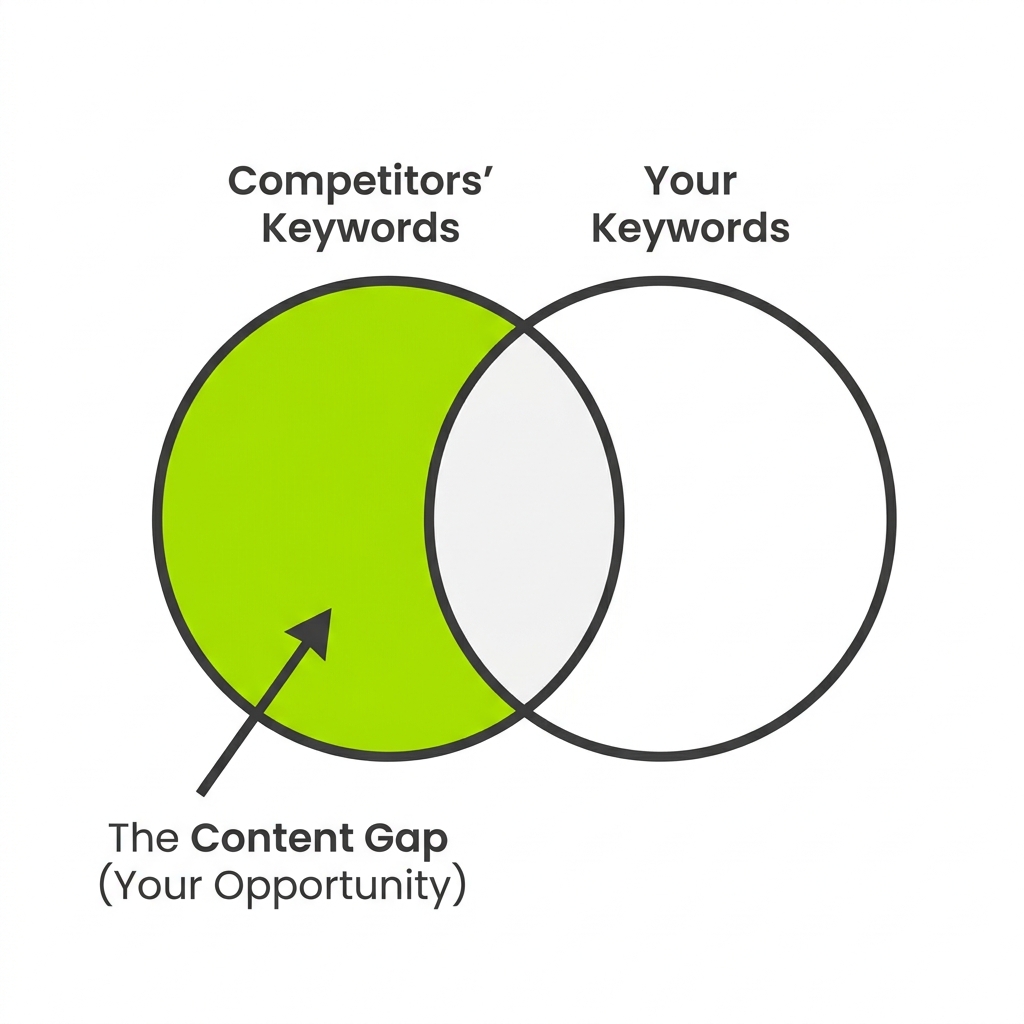
The most powerful technique is the Content Gap Analysis.
This mathematical function compares the keywords and semantic entities your website ranks for against the database of your competitors. The "Gap" represents highly profitable topics your competitors rank for, but you are completely ignoring.
In 2026, it's not just about matching exact phrases. Google looks for Topical Gaps. If a competitor covers 15 sub-topics about "Cloud Security Posture Management" and you only cover 3, Google trusts them more as an authority.
Step-by-Step Implementation
- Identify True SEO Competitors: Your local business rivals might not be your SEO competitors. Your SEO competitors are the domains consistently holding the top 3 spots in Google for your target clusters.
- Run a Domain Traffic Analysis: Plug the competitor's URL into Ahrefs or Semrush. Navigate to their "Top Pages" report.
- Analyze Top Traffic-Driving Assets: Find out exactly which pages generate 80% of their organic traffic. Are they interactive tools? Deep-dive ultimate guides? Short-form FAQs optimized for AI Overviews?
- Execute the Content Gap: Enter your domain and 3-5 competitor domains into the Content Gap tool. Look for intersection keywords (where 2 or more competitors rank, but you don't).
- Analyze the SERP Intent: Do not blindly copy. Search the gap keyword in Google to see what format Google rewards (e.g., video, listicle, software page).
- Deploy the "10x Better" Strategy: Build an asset that is infinitely more comprehensive, faster, structurally superior, and more visually engaging than theirs. Add proprietary data or expert quotes to make it immune to generic AI generation.
Actionable Steps for 2026
- Review Hijacking: Look at your competitor’s 1-star and 2-star reviews on Google My Business or Trustpilot. What are customers complaining about? If they say "Company X doesn't offer 24/7 support," write a page on your site emphasizing your 24/7 support.
- Identify Declining Content: Use Ahrefs to find pages on your competitor's site that have lost traffic over the past 12 months. This usually means their content is outdated (e.g., "2022 Tax Laws"). You can easily swoop in and steal this traffic with an updated, 2026-accurate piece.
- Featured Snippet & AI Overview Stealing: Identify questions your competitors are currently answering in the SERP. Rewrite the answer on your page to be more concise and factually dense, structured specifically for Google's AI Overviews.
Common Mistakes
- Fighting Unwinnable Battles: If your competitor is Forbes or Yelp (Domain Authority 90+), do not try to beat them on generic informational terms. Pivot to hyper-niche, localized intent where large publishers cannot compete.
- Copying Bad Strategy: A competitor might have terrible site structure but ranks purely because they've been online since 2005. Do not copy their bad UI/UX. Reverse-engineer their topics, not their execution.
- Plagiarism: Reverse-engineering strategy is brilliant. Copying and pasting their actual text is plagiarism and will trigger algorithmic demotions. Always add unique value (Information Gain).
Checklist
- I have identified my top 3 actual SEO competitors (those ranking #1-#3 for my desired terms).
- I have run their domains through an SEO tool to identify their top-performing pages.
- I have executed a Content Gap Analysis against multiple competitors to find overlapping keywords I am missing.
- I have analyzed the SERP for the gap keywords to determine the correct page format (Intent).
- I have created a roadmap to build content that provides significant "Information Gain" over what my competitors currently offer.
Practical Exercise
Even without paid tools, you can execute a manual competitor audit:
- Search your high-value commercial keyword (e.g., "Chicago SaaS Marketing Agency").
- Click on the #1 organic result (ignore sponsored ads).
- Deconstruct their page structure. What is their H1? How many H2s do they have? Do they embed video? Do they feature an interactive pricing calculator?
- Look at your own page. What trust signals, semantic entities, or interactive elements are they using that you lack? That is your immediate optimization roadmap.
AI Prompt
Act as a Senior Technical SEO Analyst. I will provide you with the text from my top competitor's landing page, followed by the text from my landing page. Analyze both documents focusing on semantic completeness, entity coverage, user intent satisfaction, and trust signals. Tell me exactly what topics and features my competitor covers that I am missing, and provide an actionable outline to upgrade my page to surpass theirs in the current 2026 Google algorithm.

Competitor Text: [Paste Text]
My Text: [Paste Text]