
Keyword Research Basics
Master the art of uncovering the exact phrases, questions, and semantic entities your target customers type into Google.
Short Summary
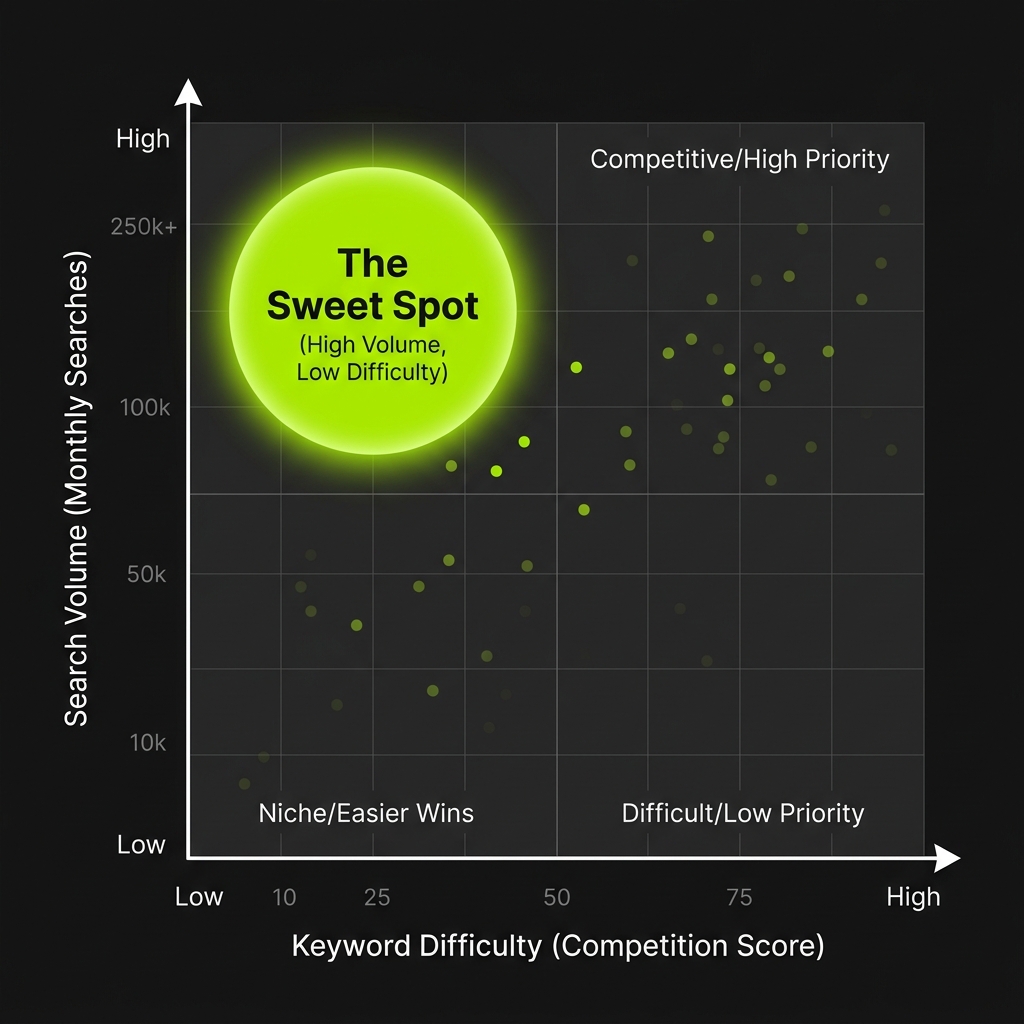
Keyword research is the absolute bedrock of every successful SEO campaign. If you target the wrong keywords, you will either get zero traffic, or you will get thousands of visitors who never pull out their credit cards. In this lesson, you will learn the core metrics of modern keyword research—Search Volume, Keyword Difficulty, and Intent Validation—and how to identify "The Sweet Spot" for rapid, scalable growth in 2026.
Imagine you are opening a high-end coffee shop. You wouldn't open it on a deserted dirt road where no one drives (zero search volume), but you also wouldn't try to open it inside an existing Starbucks (impossible keyword difficulty). Keyword research is the scientific process of finding the busiest street corner with the wealthiest customers and the weakest competition.
Real-World Analogy
Think of keyword targeting like real estate investment:
- Broad "Head" Keywords (e.g., "Shoes"): This is a billboard in Times Square. Millions of people see it, but the rent is astronomically expensive, the competition is fierce, and most people are just browsing, not buying.
- Long-Tail Keywords (e.g., "Men's waterproof trail running shoes size 10"): This is a specialized boutique in a wealthy suburb. Fewer people walk in the door, but the ones who do know exactly what they want and are ready to purchase immediately.
A Modern 2026 Real Example
An agency took on a local home services client. The client insisted they needed to rank #1 for the broad term "Landscaping" (Search Volume: 110,000 / Difficulty: 85). This is a hyper-competitive, informational keyword heavily dominated by national directories like Yelp, Angi, and Wikipedia.
Instead of wasting a year and thousands of dollars trying to rank for an impossible vanity metric, the agency executed surgical keyword research. They focused on highly specific, long-tail transactional terms like "Retaining wall installation [City]" and "Custom backyard paver patio builder" (Search Volume: 150 / Difficulty: 12).
Because the difficulty was so low, they ranked on Page 1 within four weeks. And because the commercial intent was so high, those 150 monthly searches converted into 5 high-ticket hardscaping jobs, generating over $60,000 in revenue in the very first month.
Technical Explanation: The Core Metrics
Modern keyword research relies on analyzing data points through tools like Ahrefs, Semrush, or Google Keyword Planner. You must balance three primary metrics:
- Search Volume (SV): The estimated number of times a keyword is searched per month. Caution: In 2026, raw volume is often a vanity metric. A keyword with 50 searches of pure buying intent is worth more than a keyword with 5,000 searches of tire-kickers.
- Keyword Difficulty (KD): A metric (usually 0-100) indicating how hard it will be to rank in the top 10 results. It is calculated by analyzing the backlink profiles and topical authority of the domains currently ranking.
- Cost Per Click (CPC): The amount advertisers are willing to pay for a single click on Google Ads. A high CPC is the strongest indicator of commercial viability; if companies are paying $15 for a click, that keyword makes money.
The Keyword Research Framework
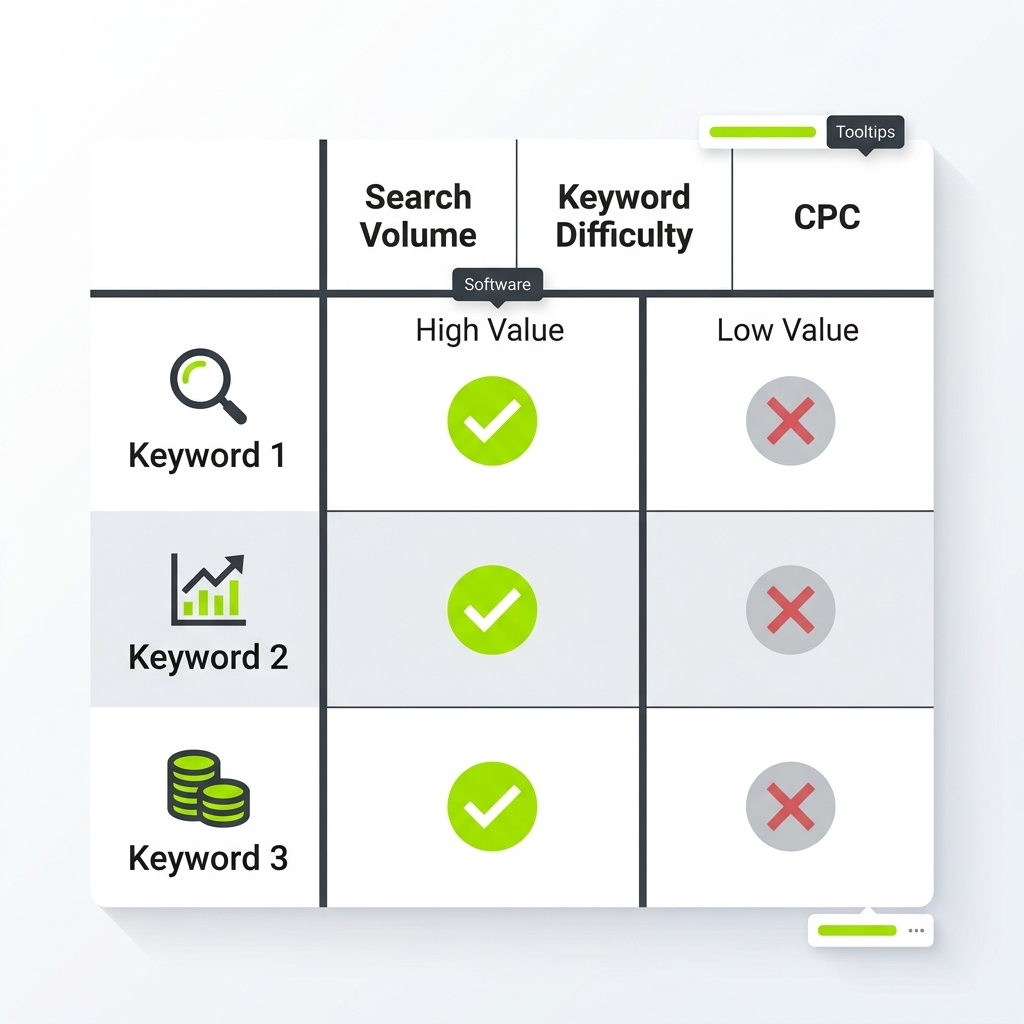
| Metric | High Value Target | Low Value Warning | What it Means for You |
|---|---|---|---|
| Search Volume | > 100/mo (Local) / > 1k/mo (Nat'l) | 0-10/mo | Are enough humans looking for this to justify the effort? |
| Keyword Difficulty | < 30 (Easy to Moderate) | > 70 (Very Hard) | Does a new/small website have a realistic mathematical chance to rank? |
| Cost Per Click (CPC) | $5.00+ | $0.00 | Does this traffic convert into actual business revenue? |
Step-by-Step Implementation
- Brainstorm Seed Topics: Do not start with tools. Start with the business. Write down the core services or products offered (e.g., "Plumbing", "Water Heaters", "Drain Cleaning").
- Expand with a Keyword Tool: Enter your seed topics into a premium SEO tool. Generate a list of thousands of related terms, questions, and phrase matches.
- Filter for the "Sweet Spot": Apply data filters. Set the maximum Keyword Difficulty to 30. Set the minimum Search Volume to a baseline that makes sense for your industry.
- Validate Intent: Filter for terms that include commercial modifiers (buy, cost, company, service, near me).
- Export, Clean, and Map: Export the refined list to a spreadsheet. Manually review the terms. Delete anomalies and group the remaining keywords into topics that will become dedicated pages on your site.
Actionable Steps for 2026
- Target "Zero Volume" Keywords: SEO tools are notoriously bad at estimating volume for hyper-niche or newly emerging topics. If you know from customer interviews or sales calls that people are asking a specific question, build a page for it—even if Ahrefs says the volume is "0".
- Analyze the AI Overview Threat: Before targeting a top-of-funnel keyword, search it. If Google answers the query entirely with a massive AI Overview and users have no reason to click through to a website, abandon the keyword. Focus on complex, subjective, or transactional terms that require a click.
- Leverage Reddit & Quora: If you see Reddit or Quora ranking on Page 1 for a keyword, that is a massive green light. It means Google wants to show human experiences (UGC) but cannot find a highly authoritative, dedicated article. You can easily outrank a forum post with a well-structured, expert-driven page.
Common Mistakes
- Chasing Vanity Volume: Ranking for "How to fix a toilet" (High Volume) will bring you thousands of DIYers from across the world who will never hire you. Ranking for "Emergency toilet repair service in Austin" (Low Volume) will bring you paying local customers.
- Ignoring Keyword Difficulty: Trying to rank a brand-new website (Domain Rating 0) for a KD 80 keyword is like a high school football team trying to play against the Kansas City Chiefs. You will get crushed. Pick battles you can win.
- Targeting Keywords with No Business Value: Just because a keyword is easy to rank for doesn't mean it drives revenue. Always tie your keyword strategy back to the actual products or services you sell.
Checklist
- I have identified 5-10 core "seed" topics based on my actual business offerings.
- I have run my seed keywords through a research tool to generate expanded lists.
- I have applied filters to find the "Sweet Spot" (low to medium difficulty, adequate volume).
- I have prioritized keywords that indicate strong commercial or transactional intent.
- I have manually checked the SERPs to ensure the keywords aren't completely cannibalized by AI Overviews or zero-click features.
Practical Exercise
- Open a free Google Ads account to access the Google Keyword Planner (or use Semrush/Ahrefs).
- Enter your main service category (e.g., "Roofing").
- Sort the resulting list of keywords by CPC (Cost Per Click) from highest to lowest.
- Notice how the highest CPC keywords are almost always long-tail, highly specific transactional queries (e.g., "commercial flat roof leak repair cost"). These are your highest-priority targets.
AI Prompt
Act as an Expert SEO Strategist. I am doing keyword research for a [Business Type, e.g., Pediatric Dentist] in [City]. Brainstorm a list of 25 "long-tail" search queries that prospective customers might type into Google.

Group these queries into three distinct categories:
1. Informational (Questions they ask before deciding)
2. Commercial (Comparisons or research)
3. Local Transactional (Ready to book right now)

For each keyword, provide a brief explanation of why it has high business value.