
Local Keyword Strategy
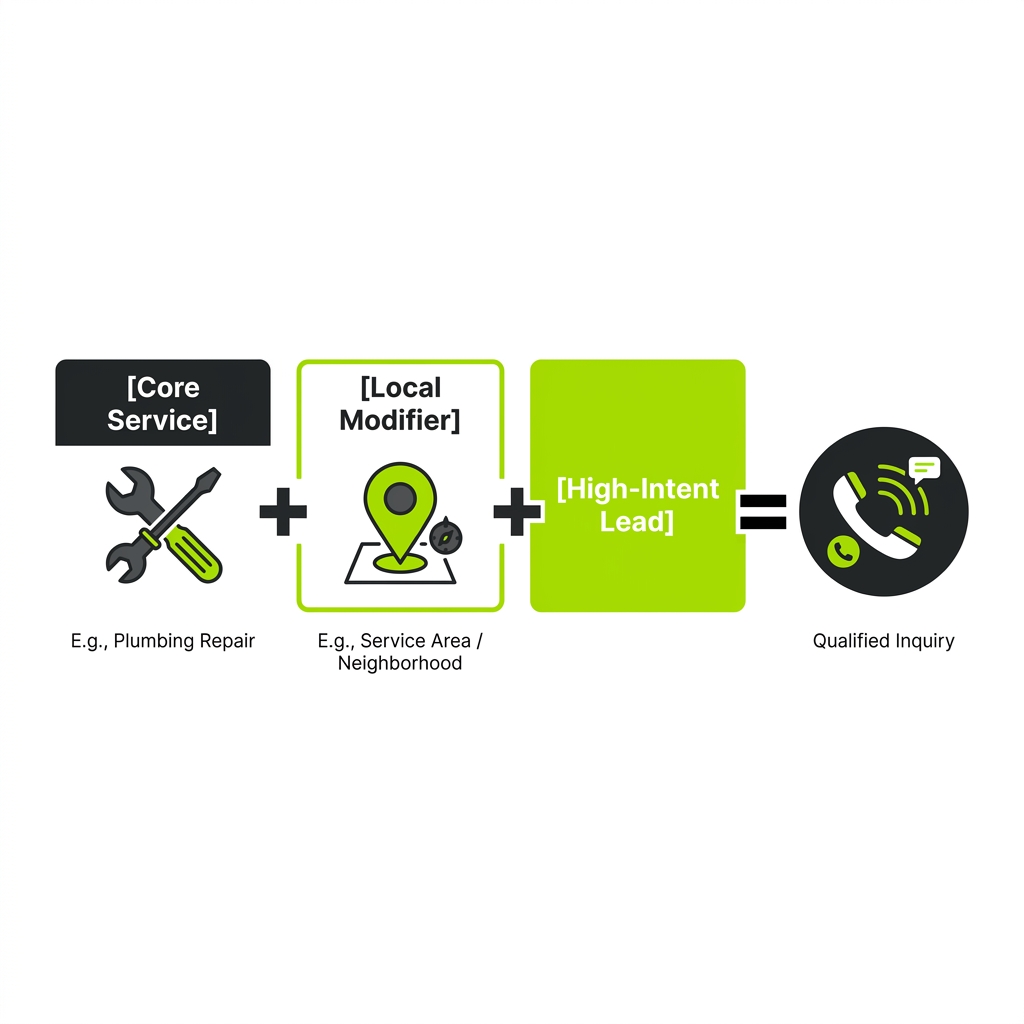
Local keyword strategy in 2026 is fundamentally different from traditional, broad keyword research. Instead of chasing high-volume, generic topics, your goal is to capture highly specific, high-intent searches tied to a precise geographical location. The rise of voice search and conversational AI queries has shifted the focus toward long-tail, natural-language phrases.
The Anatomy of a Modern Local Keyword
Local keywords typically consist of three parts: the Intent Modifier, the Core Service, and the Geo-Modifier.
Intent Modifier
- "Best..."
- "Affordable..."
- "Emergency..."
- "Top-rated..."
Core Service
- "...EV charging installer..."
- "...personal injury lawyer..."
- "...vegan bakery..."
- "...roof repair..."
Geo-Modifier
- "...in Chicago"
- "...near me"
- "...Brooklyn NY"
- "...open now"
Types of Geo-Modifiers
When building out your local keyword matrix, you must account for how people—and their devices—actually search for locations.
- City Names: "Electrician in Denver"
- Neighborhoods/Districts: "Electrician in LoDo" (Hyper-local search is growing rapidly)
- Counties/Regions: "Electrician in Boulder County"
- "Near Me" / Proximity Searches: "Electrician near me" or "Electrician open now"
[!IMPORTANT]
You cannot explicitly optimize for "near me" by stuffing the phrase "near me" repeatedly on your website. Google calculates "near me" dynamically based on the user's real-time GPS location. You win these searches by establishing immense relevance for the core service and having a highly optimized Google Business Profile.
Building Your Local Keyword Matrix
The most effective way to architect a local strategy is through a multiplier matrix. You take your list of granular services, multiply them by your intent modifiers, and cross-reference them with your service areas.
The Strategy for Service Area Businesses (SABs)
If you travel to your customers (e.g., plumbers, landscapers, mobile detailers), you cannot rely on a single homepage to rank everywhere. You must create a dedicated "Location Page" or "City Page" for every major area you service.
Actionable Steps for Location Pages:
- Wrong: Dumping 50 city names into a single comma-separated paragraph in your footer. This is seen as spam in modern SEO.
- Right: Creating distinct pages like
yourdomain.com/service-areas/austinandyourdomain.com/service-areas/round-rock. Each must feature unique content, localized testimonials, photos of projects completed in that specific city, and embedded maps.
Capturing Voice and Conversational AI Queries
In 2026, many local searches happen via voice assistants ("Hey Siri, find a 24-hour plumber near me"). To capture these:
- Optimize for questions. Use an FAQ section on your location pages answering things like "How much does roof repair cost in Austin?"
- Use natural, conversational language rather than stilted keyword insertions.