How Search Engines Work
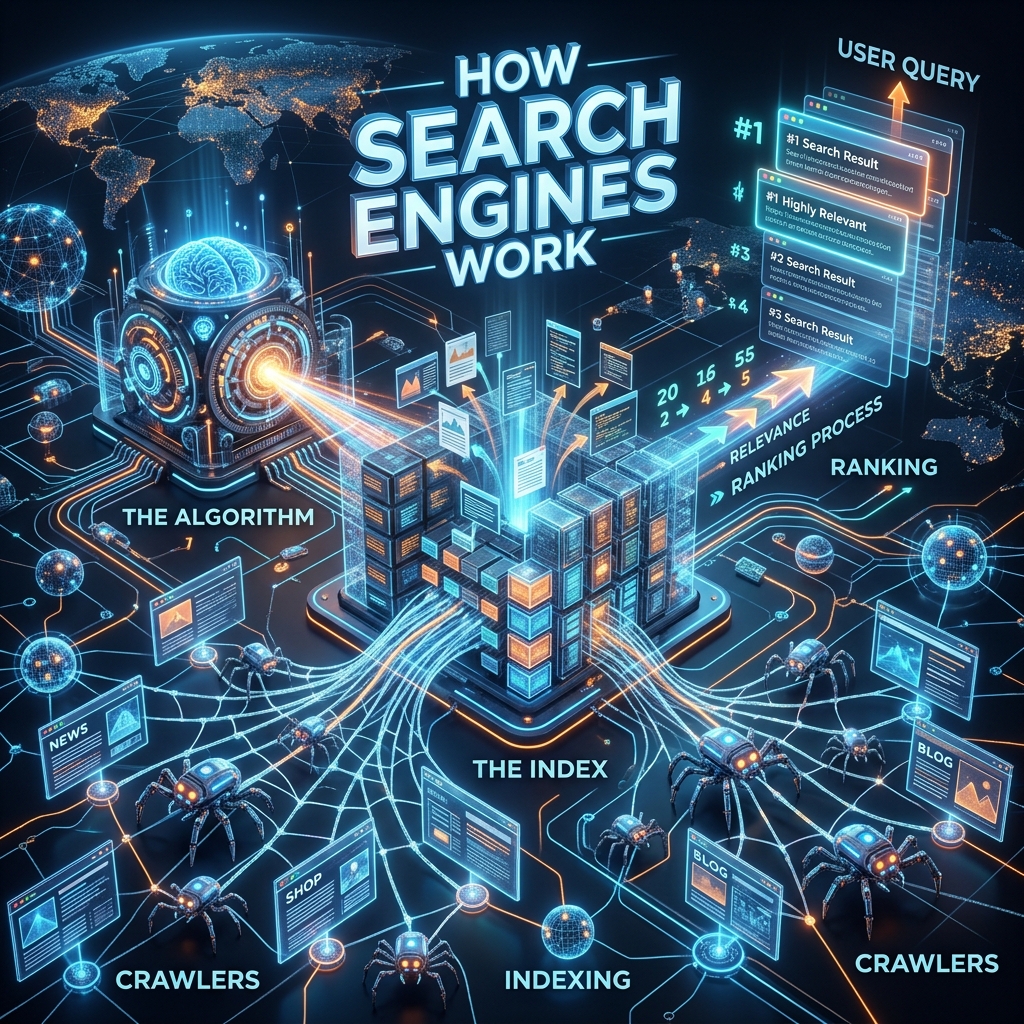
Uncover the three fundamental pillars of search engines: crawling, indexing, and ranking. Master these concepts to ensure your websites are fully visible to Google's sophisticated AI-driven algorithms in 2026.
Short Summary
To rank websites, dominate the SERPs, and generate leads, you must first understand the pipeline of how Google discovers your pages (Crawling), processes and stores your information (Indexing), and evaluates who deserves the top spot (Ranking). If your site fails at step one, step three is impossible. With modern innovations like AI Overviews and aggressive JavaScript rendering, securing this technical pipeline is your highest priority.
Imagine Google is an incredibly vast, magical library that holds every book in the world, managed by an AI super-librarian.
- Crawling: The librarian sends out automated scouts to drive around finding newly published books.
- Indexing: The scouts bring the books back. The librarian reads them, uses natural language processing to deeply understand the context, and files them into the correct conceptual sections.
- Ranking: When a user asks for a book on "how to bake a cake," the librarian instantly evaluates millions of options and hands over the single most authoritative, helpful book, while sometimes offering a summarized AI recipe on the spot.
Real-World Analogy
If you spend thousands of dollars printing 1,000 gorgeous flyers for your new landscaping business but leave them sealed in a box in your trunk, nobody will call you. You must hand them out (crawl) and stick them on public community boards (index) for people to actually see them and decide to hire you (rank).
A beautifully designed React website that isn't accessible to Googlebot is just a stack of expensive flyers locked in a dark trunk.
Real Example (2026 Context)
An agency builds a stunning new Headless CMS website for a local aircon repair company on a staging server. To prevent search engines from indexing the unfinished work, the developer adds a noindex tag and blocks the staging domain in robots.txt.
When the site is deployed to production, they forget to remove these directives. Google's automated bot (Googlebot) visits the live site, reads the noindex instruction, and aborts immediately. The client furiously wonders why their organic traffic flatlined for three months. The site wasn't indexed, which explicitly meant it couldn't be ranked. A simple technical oversight destroyed their visibility.
Technical Explanation: The Modern Pipeline
Search engines operate through three incredibly complex, resource-intensive functions:
- Crawling: Google uses automated programmatic spiders (like Googlebot). These bots traverse the web by extracting and following
hreflinks from one page to another. Before crawling a domain, they strictly read therobots.txtfile to respect crawl rules. They also rely on dynamic XML Sitemaps to efficiently discover newly published URLs without needing to crawl the entire site tree. - Indexing & Rendering: Once a URL is crawled, Google evaluates the payload. In 2026, this involves executing the JavaScript (Rendering) to see the final DOM structure exactly as a user would. It analyzes the text, structured data, images, and embedded videos to extract semantic meaning. If the page is high-quality, not a duplicate, and provides genuine value, it gets committed to the Google Index—an unfathomably large database of the known web.
- Ranking & AI Generation: When a user issues a query, Google queries its index to fetch highly relevant pages. The ranking algorithm weighs hundreds of dynamic signals in milliseconds—including topical relevance, E-E-A-T (Authority/Trust), Core Web Vitals (Speed/UX), and spatial location. Furthermore, it determines if an AI Overview should be generated dynamically at the top of the SERP to synthesize the best answers instantly.
Step-by-Step Implementation
To ensure your client sites are flawlessly crawled and indexed:
- Audit
robots.txt: Verify your live site is not accidentally blocking Googlebot from critical directories. - Automate XML Sitemaps: Ensure your framework (Next.js, Astro, or WordPress) automatically generates and updates an XML sitemap when new content is published.
- Submit via Google Search Console (GSC): Manually submit your sitemap to GSC. Monitor the "Pages" report religiously to identify indexing errors.
- Implement Robust Internal Linking: Ensure every crucial page has contextual inbound links from other strong pages on your site. Pages without inbound links are "orphan pages" and represent dead-ends for crawlers.
- Optimize Server Response Times: Google allocates a specific "crawl budget" to your site. Fast server response times mean Googlebot can crawl more of your URLs per visit.
Common Mistakes
- Deploying with "Noindex" Tags: Migrating from staging to production while accidentally retaining the
noindexmeta tags. - JavaScript Rendering Blocks: Building heavily client-side rendered (CSR) apps without implementing Server-Side Rendering (SSR) or Static Site Generation (SSG), leaving Googlebot to stare at a blank
<div id="root"></div>. - Assuming Instant Indexation: Believing a new page will rank 5 minutes after clicking publish. Depending on your domain authority and crawl budget, indexation can take anywhere from a few hours to several weeks.
Actionable Checklist
- I have verified the production website's
robots.txtallows crawling. - I have generated, located, and validated the dynamic XML sitemap.
- I have submitted the sitemap directly to Google Search Console.
- I have aggressively audited the source code to ensure there are no stray
noindextags on money pages. - I have implemented logical internal linking to prevent orphan pages.
Practical Exercise
- Open Google.
- Type the search operator
site:yourdomain.com(replace with an actual client or portfolio website). - Hit enter.
- Observe the estimated number of results. This reveals exactly how many URLs Google currently has stored in its index for that specific domain. If the number is suspiciously low (or artificially inflated by duplicate tags), you have a massive indexing issue to solve.
AI Prompt
Use this prompt to translate complex crawling concepts into reassuring client communication.
Act as a seasoned Technical SEO Consultant. My client, a local pest control company, recently launched a redesign but is panicked because they aren't showing up on Google yet. Write a highly reassuring, jargon-free email explaining the concepts of "crawling" and "indexing." Clearly outline the proactive steps we are currently taking (like submitting sitemaps to Search Console and forcing re-indexing) to expedite the process.