Internal Linking & Siloing
Internal links are the undisputed hidden superpower of technical and content SEO. While your competitors are burning budgets desperately trying to acquire external backlinks, you can consistently outrank them by intelligently routing the authority you already possess through a highly optimized internal linking matrix.
Short Summary
An internal link is simply a hyperlink pointing from one page on your website to another page on the same domain. In 2026, internal links serve three critical, AI-focused functions:
- User Journey & UX: They keep users engaged, reducing bounce rates and improving Interaction to Next Paint (INP) session metrics.
- Crawl Efficiency: They create pathways for search engine bots to rapidly discover and index new or updated content.
- Authority Distribution (PageRank): They pass mathematical "link equity" and semantic relevance from your powerful pages to your newly published, weaker pages.
Think of domain authority (PageRank) like a massive reservoir of water. Your homepage is the main dam holding that water. Every internal link you create is a pipe. By strategically placing internal links, you control exactly which pages receive a flood of authority, and which pages stay dry. Internal linking is the plumbing system of your website's organic visibility.
The Hub and Spoke Model (Topic Siloing)
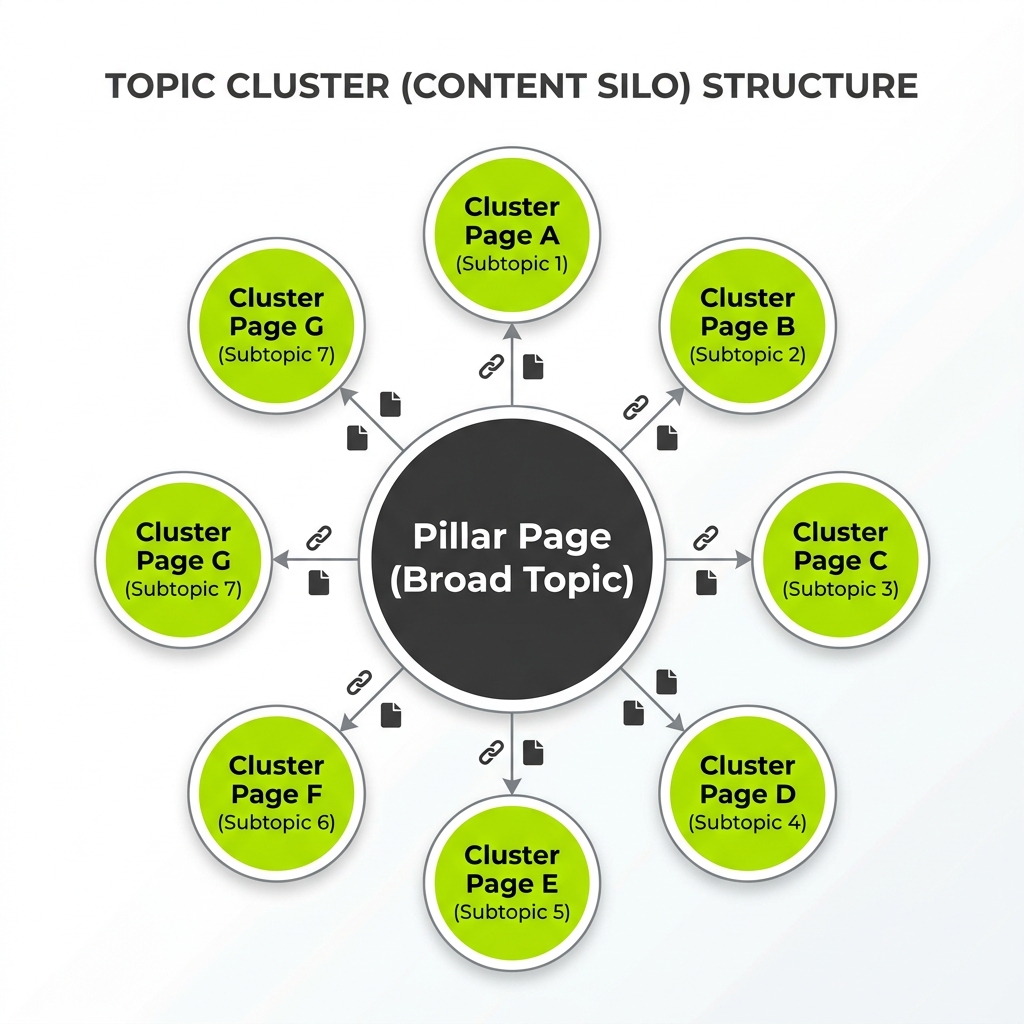
Siloing (also known as the Hub and Spoke model or Topic Clusters) is an advanced architectural strategy where you group hyper-relevant content together to establish massive, undeniable "Topical Authority."
Instead of publishing 50 disparate blog posts on random industry topics, you architect a connected ecosystem:
- The Hub Page (The Pillar): A comprehensive, top-level overview of a broad subject. (e.g., "The Ultimate Guide to Digital Marketing").
- The Spoke Pages (The Clusters): Highly specific, long-tail articles that dive deep into sub-topics. (e.g., "Email Marketing Automation," "B2B SEO Strategy," "TikTok Ad Bidding").
The Engineering Magic: Every Spoke Page must link back up to the Hub Page. The Hub Page links down to every Spoke Page. Crucially, the Spoke Pages link to each other when contextually relevant. This creates a tightly woven web of semantic relevance that trains AI search engines to view your domain as an absolute, centralized authority on the core entity (Digital Marketing).
Advanced Anchor Text Strategy for 2026
The clickable text of a hyperlink is called Anchor Text. Search engines utilize the anchor text of an internal link as one of the strongest ranking signals to determine the destination page's target keyword.
- Terrible Anchor Text: "To learn about our cloud migration services, click here." (Passes zero semantic context)
- Mediocre Anchor Text: "We offer cloud migration services." (Better, but highly generic)
- Optimized 2026 Anchor Text: "Transitioning legacy servers requires a robust enterprise AWS cloud migration strategy to prevent data loss." (Hyper-specific, highly contextual, entity-rich)
Pro-Tip: Unlike external backlinks where too many exact-match anchors can trigger a spam penalty, Google allows you to be highly aggressive with internal anchor text. Use your exact target keywords, but vary them slightly using NLP (Natural Language Processing) synonyms to build a broad semantic profile.
Real-World Impact
A SaaS enterprise had a beautifully designed feature page for their "AI Sales Dashboard," but it was stuck on Page 3 of Google for 8 months.
A technical audit revealed the page was an Orphan Page—meaning literally zero other pages within their architecture linked to it. Google's crawlers could barely find it, and no PageRank was flowing into it.
The SEO team identified their 15 highest-traffic blog posts, injected a relevant paragraph into each, and added a descriptive, keyword-rich internal link pointing directly to the "AI Sales Dashboard" page. Within 72 hours of the links being indexed, the page skyrocketed from Page 3 to Position #4 on Page 1.
Contextual Links vs. Navigational Links
Not all internal links are created equal.
- Navigational Links (found in your header, footer, or sidebar) pass basic crawlability but carry lower semantic weight because they are boilerplate.
- Contextual Links (hyperlinks embedded directly within the unique body text of an article) are the holy grail. They pass maximum PageRank and immense semantic value. Always prioritize contextual internal linking.
Checklist
- My homepage explicitly links to my most important "Money Pages" (Core Services/Products).
- I am using descriptive, keyword-rich, varied anchor text for all internal links.
- I have structured my content into logical "Silos" (Hub and Spoke model) to build topical authority.
- I prioritize in-content contextual links over just adding links to footers/sidebars.
- I have run a crawl audit (via Screaming Frog or Sitebulb) to ensure my architecture contains zero "Orphan Pages".