Planning Site Architecture
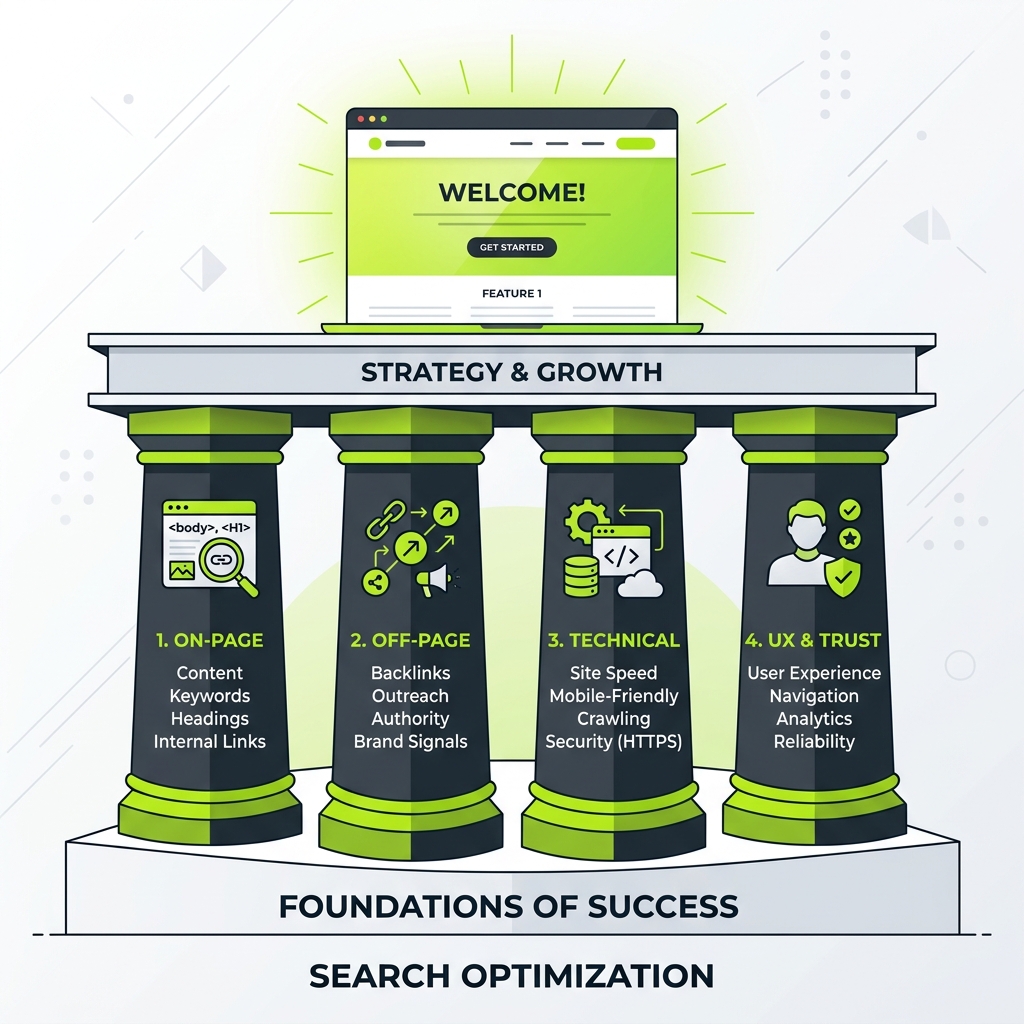
Your website's architecture (or Information Architecture) is the foundational blueprint of your SEO success. As of 2026, search engines are leveraging advanced AI and semantic web technologies to interpret websites not just as collections of pages, but as interconnected knowledge graphs. If Google's AI crawlers cannot logically traverse your site, or if users get lost trying to navigate your content, even the most profound content will fail to rank.
Short Summary
Site architecture dictates how your website's pages are grouped, linked, logically structured, and technically presented. A robust architecture creates a seamless user experience (UX) and enables search engine crawlers to allocate their "Crawl Budget" efficiently—understanding the hierarchy, context, and semantic relationship between different entities on your site.
Think of your website like a vast digital library. If the books are tossed randomly on the floor, nobody—human or AI—can find what they need. Site architecture is the process of building categorized shelves, establishing distinct aisles (silos), and creating an intuitive, cross-referenced catalog (navigation & internal links) so every asset is immediately accessible.
The "Flat" vs. "Deep" Architecture
When planning your site structure, the modern 2026 consensus strongly favors a Flat Architecture, typically organized in a Hub-and-Spoke model. This structural design ensures that any page on your website—no matter how buried—is accessible within 3 to 4 clicks from the homepage.
| Feature | Flat Architecture (Recommended) | Deep Architecture (Avoid) |
|---|---|---|
| Click Depth | 1-3 clicks to reach any core entity page | 4+ clicks to reach deep pages |
| Crawlability | Exceptional. Googlebot easily crawls all nodes without abandoning the session. | Poor. Deeply nested pages are often treated as "Orphaned" and ignored. |
| User Experience (UX) | Intuitive, fast navigation suitable for zero-click environments. | Frustrating. Users get lost in multi-tiered, complex sub-menus. |
| Authority Flow (PageRank) | "Link equity" flows abundantly and directly from high-authority pages (like the homepage). | Authority aggressively dilutes before reaching bottom-tier pages. |
Real-World 2026 Example
A major e-commerce storefront utilizing a headless CMS was struggling to index its newest product variations. Their structure was technically logical but practically disastrous:
Home > Shop > Men's Apparel > Footwear > Athletic Shoes > Running > Nike > Nike Air Zoom Pegasus 41 (8 clicks deep!)
Because the product pages were buried so deeply, Google’s efficiency-focused crawl bots abandoned the path early, assuming the deep URLs held low value.
The SEO team flattened the architecture and introduced dynamic filtering:
Home > Men's Running Shoes > Nike Air Zoom Pegasus 41 (2 clicks deep)
Within 48 hours of flattening the architecture and deploying an updated XML sitemap, Google indexed the new product URLs, and AI Overview (AIO) inclusion for long-tail queries surged by 412%.
Modern Taxonomy and Ontology
In 2026, it is not enough to just categorize pages (Taxonomy). You must also define the relationships between them (Ontology).
- Taxonomy: Organizing your blog into categories like
SEO,Content Marketing, andSocial Media. - Ontology: Linking a guide on "Keyword Research" (SEO) to a guide on "Writing Viral Posts" (Content Marketing) using contextually relevant anchor text, signaling to Google how these distinct topics overlap.
Actionable Steps for Building Your Architecture
- Conduct a Reverse Card Sort: Take your top 50 target keywords and group them into 4-6 primary "Buckets." These buckets will become your top-level navigation items.
- Implement the "Rule of 3 Clicks": Audit your site using a crawler like Screaming Frog. If any "Money Page" (a page designed to generate revenue or leads) has a crawl depth of 4 or higher, you need to elevate it via homepage links, footer links, or HTML sitemaps.
- Deploy HTML Sitemaps: While XML sitemaps are for bots, a dedicated
/sitemapHTML page listing links to all major hubs and categories serves as a powerful secondary navigation tool that distributes PageRank equitably across your ecosystem. - Prune Ruthlessly: If a category only has one or two pages, it doesn't deserve to be a top-level category. Merge it into a broader hub to maintain structural density.
Checklist
- I have mapped out my website structure visually using a diagramming tool (e.g., Miro, Lucidchart).
- My primary navigation menu utilizes my highest-volume, highest-intent core keywords.
- No "Money Page" or critical content is more than 3 clicks away from the homepage.
- I have established a clear taxonomy (categories) and ontology (internal linking relationships).
- I utilize both an XML sitemap (for bots) and an HTML sitemap (for humans and authority distribution).